Executive Summary
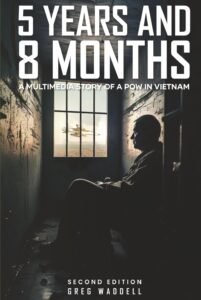
5 Years and 8 Months is a groundbreaking multimedia memoir that captures the harrowing reality of 2,069 days in captivity through the actual voice of the man who lived it. Unlike traditional memoirs polished by time and editors, this project is built upon 18 raw, candid cassette tapes recorded by Col. Wayne Waddell in the early 1990s.
This is more than a book; it is a “living archive.” It bridges the gap between the cockpit of a Mach 2 F-105 Thunderchief, the brutal interrogation rooms of the “Hanoi Hilton,” and the modern reader’s digital experience.
Narrative Highlights
I. The High-Speed War (Episodes 1–2)
The story opens in 1967 at Takhli, Thailand. Wayne Waddell describes the terrifying math of the Vietnam air war: a 50% chance of being shot down and only a 25% chance of returning home. The manuscript provides a rare, gritty look at “vanity flying” and the internal frictions of a squadron where pilots were the “precision systems” long before smart bombs existed.
II. Captivity and the Psychological Front (Episodes 3–6)
Shot down on July 5, 1967, Waddell’s journey through the Hoa Lo Prison (Hanoi Hilton) begins. The narrative shines in its details of resistance:
- The Disappearing Ink Trick: A brilliant display of prisoner wit used to outsmart interrogators.
- The Tap Code: The rhythmic lifeline that allowed men in solitary confinement to organize and maintain their sanity.
- A New Mission: Waddell’s transition from fighter pilot to caregiver as he tends to fellow prisoner Captain Fuller, finding strength in a shared struggle.
III. The Propaganda and The “Cuban Program” (Episodes 7–12)
The manuscript pulls back the curtain on the “Cuban Program,” a chilling period of specialized exploitation, and the psychological warfare of “The Rat.” Yet, amidst the hunger and “Lake Fester,” Waddell captures moments of profound humanity—clandestine Christmas choirs, the shared irony of Ho Chi Minh’s death, and the “harrowing culinary adventures” that turned survival into a form of defiance.
IV. Unity and the Long Road Home (Episodes 13–18)
Following the famed Son Tay Raid, the prisoners were consolidated into “Unity.” Here, Waddell describes a sophisticated prison society featuring “Toastmasters” meetings and educational programs. The emotional core of the book peaks as Waddell eulogizes his own father from within a cell in “Dogpatch,” a remote mountain camp.
The odyssey concludes with Operation Homecoming in 1973. The reader “hears” the first breath of freedom on the C-141 Starlifter and the surreal, emotional return to a family and a country that had changed forever.