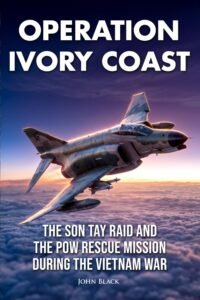
The Son Tay Raid and the POW rescue mission during the Vietnam war is one of modern POW special operations. The mission had codenames Operation Ivory Coast and Operation Kingpin. This book takes readers inside the planning rooms, the mock compound at Eglin, the cockpits over Laos, and the prison courtyard at Son Tay to show how a raid that rescued no prisoners still changed the way America fights and cares for its own.
Built on official Army and Air Force histories, declassified planning documents, CIA analytical material, and participant memoirs, this volume follows the story from the first escalation of air operations over North Vietnam and the growing POW crisis, through General Blackburn’s feasibility study and President Nixon’s decision to approve a joint rescue force, to Brigadier General LeRoy Manor and Colonel Arthur “Bull” Simons assembling an ad hoc task force that trained in total secrecy. Readers see how intelligence analysts identified Son Tay, how MACV-SOG and CIA photography teams struggled against cloud cover, and how the Joint Contingency Task Group became an early model for joint special operations.
Inside the raid, the book takes you through the night training at Eglin, the three-element ground organization of Blueboy, Greenleaf, and Redwine, and the air package of Combat Talon C‑130s, HH‑3 and HH‑53 Jolly Green Giants, A‑1 Skyraiders, F‑105 Wild Weasels, and Navy diversionary air wings from USS Oriskany and USS Ranger. It explains why Banana 1 was chosen to crash inside the compound, how Apple 3’s miniguns shredded the guard towers in seconds, and how a navigation error put Simons’s Greenleaf element into the wrong compound and an unexpected firefight without costing a single raider’s life.
Unlike summary treatments, this book separates confirmed facts from reasonable conclusions and shows where historians disagree. It unpacks the intelligence failure behind the empty camp, traces the July 1970 relocation of Son Tay’s prisoners to the nearby “Camp Faith,” and explores the competing explanations for that move. It then follows the story into Washington, examining Melvin Laird’s press conference, congressional criticism, and the media’s “failure” narrative, before turning to the POWs themselves to show how the raid forced North Vietnam to consolidate prisoners, improve treatment, and inadvertently raise morale in camps like Hoa Lo.
Where this book truly stands apart is in its doctrinal and institutional analysis. It shows how Son Tay became a blueprint for later missions, from Colonel Charlie Beckwith and Dick Meadows building Delta Force at Fort Bragg to the painful lessons of Desert One and the creation of Joint Special Operations Command. It places the raid alongside modern operations such as the rescue of Jessica Lynch as part of a continuous lineage of hostage rescue and personnel recovery doctrine, backed by a complete chronology, biographical directory, unit and equipment appendices, and an intelligence focused historiography that addresses myths head on.
Written for serious readers of military history, Vietnam War scholarship, and special operations professionals, this book offers a premium, chapter‑rich narrative that reads like a major military history title instead of a brief overview. It is equally suited for Kindle and paperback, with a structure that lets you dive into planning, training, execution, intelligence, POW experience, and legacy in turn. If you want more than the story of one night, and you want to understand how that night reshaped American special operations, Son Tay Raid Vietnam POW Rescue belongs on your shelf.